From browser profiles to C2: how the stealer collects, stages, and exfiltrates credentials, cookies, and wallets.
Acreed showed up in 2025, after the RedLine disruption and the May takedown of Lumma. In a few months it went from nearly absent in some datasets to a regular name on Russian Market and other log shops.
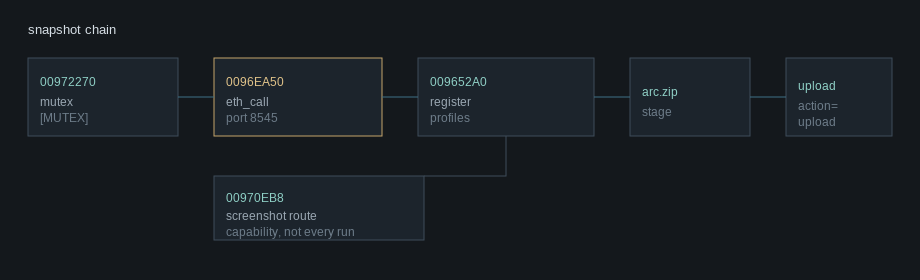
The chart is the short part. The reversing is how the work is split: resolve a host, register the machine, collect locally, stage, upload. A WebView2 carrier and calls to BNB Smart Chain testnet sit in that same chain.
Two questions stay apart:
- Threat landscape: what does Acreed’s apparent rise actually tell us?
- Reverse engineering: what can we support from the unpacked snapshot we analyzed?
Public write-ups describe more than one Acreed build. The function notes below are this artifact. Third-party claims are marked. Thin evidence stays at a lower confidence.
TL;DR
- Acreed appeared publicly in early 2025 and rapidly gained ground in the infostealer ecosystem.
- In the 21–28 September 2026 InfoStealers/Hudson Rock weekly report, 6,813 machines were labeled Acreed, compared with 19,036 Generic Stealer and 302 Lumma.
- Those figures are not directly comparable to percentages from other vendors without checking methodology, denominator, and indexing date.
- The analyzed artifact uses a WebView2-related carrier, while the data-theft logic appears in a separate unpacked snapshot.
- We observed a BNB Smart Chain Testnet-based C2-resolution routine using
eth_call and an encoded result that is transformed before being used.
- A large registration/collection routine walks Chrome, Edge, and Brave profiles, extension state, and multiple wallet locations.
- The network flow separates at least registration, upload, and a screenshot-related path.
- Several distinct user-agents are embedded in different functions, including
POSTGEN, POSDATAGENT, and DLAGENT.
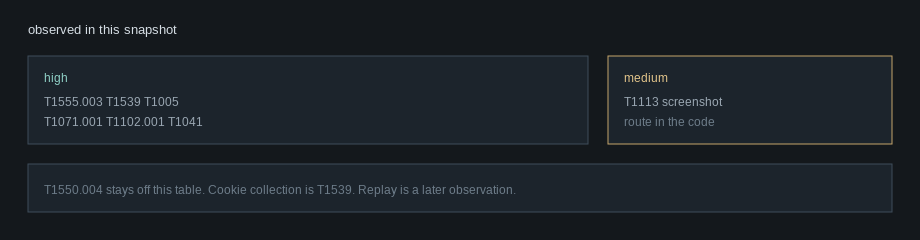
- For ATT&CK, we map T1539 (Steal Web Session Cookie) where cookie theft is supported. We do not map T1550.004 as observed stealer behavior, because stealing a cookie does not prove the cookie was later replayed.
1. Why Acreed matters
Acreed’s growth is real, but the numbers need context.
ReliaQuest observed Acreed climbing to second place behind Lumma in Russian Market during Q1 2025 and highlighted it as a likely beneficiary of the post-Lumma vacuum. Bitsight documented a rapid increase in Acreed-associated logs on criminal markets during 2025. Intrinsec later placed it near 17% market share in a September 2025 snapshot within its own visibility.
A year later, public sensors still measure different things.
InfoStealers/Hudson Rock reported the following family counts for 21–28 September 2026:
That makes Acreed the largest specifically named family in that weekly dataset, but it does not establish a universal market-share percentage. A much larger set remains under the Generic Stealer label.
Breachsense’s August 2026 report illustrates the attribution problem from another angle. It indexed 133,005,847 credential records from 1,217,555 machines, but only 44.7 million credential records carried a defined malware family. Meta, RedLine, StealC, and Vidar dominated that attributed slice.
A ranking describes the sensor that produced it.
Before comparing charts, ask:
- Is the vendor counting machines, credential records, or logs?
- Does the date represent infection, publication, or indexing?
- What fraction of the dataset has a family attribution?
- Can the same machine appear more than once?
- How much activity is absorbed into a Generic category?
2. The artifact we analyzed
The primary artifact behind this reverse-engineering section is:
SHA-256
c84f48d7f383a98220b8d3aa851b0c6b6516c4fe6c90ba4dbee8be2d7164ce73
On-disk carrier
The on-disk file presents as:
The TimeDateStamp is 2021. That date belongs to the WebView2 carrier: the PDB path and OriginalFilename are WebView2Loader.dll. The theft logic sits in an unpacked snapshot based around 0x00940000.
Section layout
.text does not, by itself, look like a classic high-entropy packed section. The non-standard jehd section is more notable from a triage perspective.
3. A more modular theft flow than the name suggests
The work is split across functions.
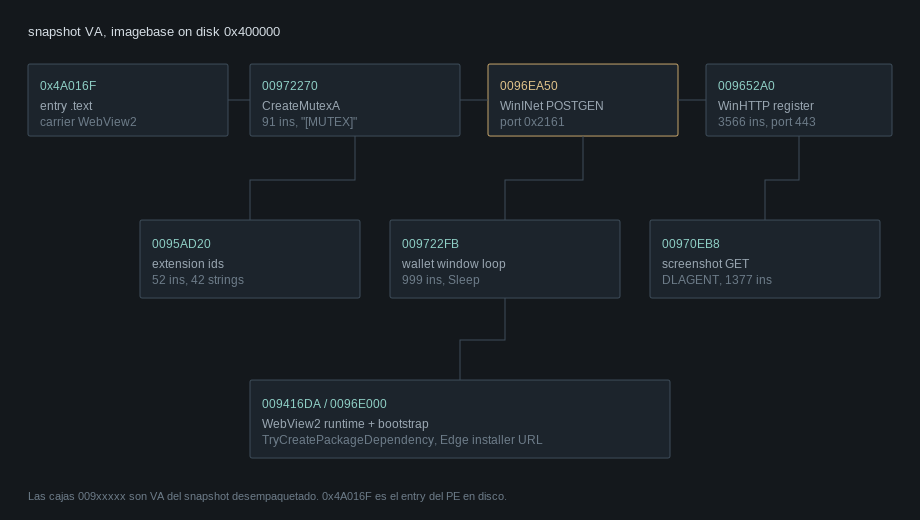
The observed chain separates into:
- Execution guard / mutex
- Dynamic C2 resolution
- Victim registration
- Browser and wallet collection
- Staging
- Upload / exfiltration
- Auxiliary capabilities
That separation matters. Infrastructure can move without requiring the full collector to change, and different network routines can serve distinct operational purposes.
4. 00972270: mutex and instance control
The function at 00972270 contains a straightforward sequence:
CreateMutexA(NULL, FALSE, "[MUTEX]")
GetLastError()
The [MUTEX] string is referenced inside the same function.
A single-instance guard. If the mutex is already there, GetLastError returns ERROR_ALREADY_EXISTS (183) and the second copy can exit.
The string is still a decent pivot. It lives in memory, it can survive a domain rotation, and the same literal may show up in related builds.
5. 0096EA50: BNB Smart Chain as a C2 resolver
This is the dead drop.
The function uses WinINet with the embedded user-agent:
POSTGEN
and follows a sequence similar to:
InternetOpenA(...)
InternetConnectA(..., port 8545, ...)
HttpOpenRequestA(..., "POST", ...)
HttpSendRequestA(...)
InternetReadFile(...)
The same routine contains:
eth_call
"result":
plus an embedded JSON-RPC body.
The immediate host is a public BNB Smart Chain Testnet RPC endpoint. The malware queries a smart contract, searches the response for "result", and transforms the returned value before using it in the next stage of C2 handling.
Intrinsec independently documented the same design for Acreed: BNB Smart Chain Testnet smart contracts acting as dead-drop resolvers.
That maps to:
- T1102.001 — Web Service: Dead Drop Resolver
- T1071.001 — Application Layer Protocol: Web Protocols
What to alert on
A blanket block of public BNB infrastructure will mostly hit people using the chain.
The combination that matters:
- unusual process context,
- JSON-RPC
eth_call,
- port
8545,
- and subsequent outbound traffic to newly resolved infrastructure.
6. 009652A0: registration and collection core
This function is much larger, with thousands of instructions and over a hundred strings.
It uses WinHTTP and contains the user-agent:
POSDATAGENT
It also references endpoints such as:
/api.php?action=register
/api.php?action=upload
The registration form builds fields including:
userAgent=
&IDF=
&tag=
&Machine=
and reads COMPUTERNAME.
Browser targeting
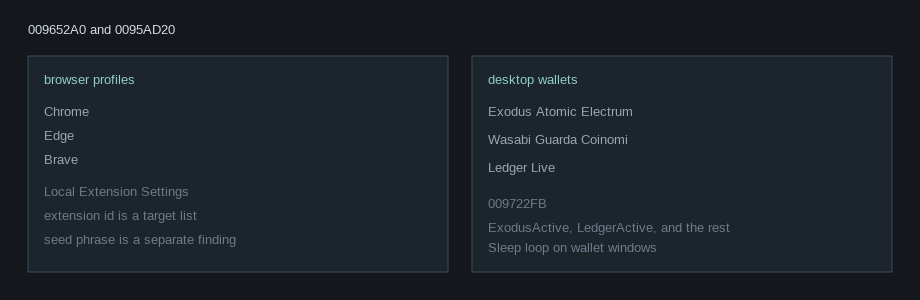
The same function contains paths for:
\Google\Chrome\User Data
\Microsoft\Edge\User Data
\BraveSoftware\Brave-Browser\User Data
along with process names:
chrome.exe
msedge.exe
brave.exe
and:
\Local Extension Settings\
That is the profile collection: credentials, cookies, autofill, and extension state.
Staging
The same routine contains:
arc.zip
near the upload workflow.
The filename alone does not prove the archive contents, but its position next to profile walking and upload logic supports the pattern:
collection → staging → compression → upload
7. 0095AD20: extension targeting
A much smaller function concentrates dozens of extension IDs and Chromium switches:
--load-extension=
--disable-extensions-except=
\Local Extension Settings\
\Direct\
Observed extension IDs map to well-known wallets including:
- MetaMask
- Phantom
- Tron
- OKX
- Binance
- Coinbase
- Crypto.com
An extension ID means the collector looks for that wallet's local state. It is a targeting list. Seed-phrase theft needs a separate finding.
8. Desktop wallets
The main collector also references local paths associated with:
Exodus
Atomic
Electrum
Wasabi
Guarda
Coinomi
Ledger Live
Another routine, around 009722FB, includes markers such as:
ExodusActive
LedgerActive
AtomicActive
BitboxActive
TrezorActive
ElectrumActive
CoinomiActive
GuardaActive
MoneroActive
WasabiActive
DaedalusActive
alongside multiple timed Sleep() calls.
Those markers plus the sleeps look like a loop waiting on wallet windows.
9. Screenshot: capability vs. execution
The function at 00970EB8 contains strings including:
DLAGENT
/api.php?action=screenshot
/api.php?action=
/testarc.zip
plus references to both http:// and https://.
That is enough to describe a screenshot-related capability or route in the analyzed code.
It is not enough, on its own, to prove that every execution captures the screen.
For that reason, our ATT&CK table marks T1113 with medium confidence rather than treating it as universally executed behavior.
10. WebView2 beside the theft logic
A separate portion of the binary deals with WebView2:
- runtime discovery,
- package checks,
- fallback installer download,
EmbeddedBrowserWebView.dll handling.
This helps explain the carrier and possible browser-based modules, but it should not be confused with the collector itself.
The core theft behavior is concentrated in the browser/wallet collection and staging/upload paths.
11. ATT&CK mapping with confidence
Left off the observed-behavior column
T1550.004 is "Use Alternate Authentication Material: Web Session Cookie."
Cookie collection is T1539. T1550.004 would need a later step: Acreed, or something next to it, replaying the cookie to log in. That step is an incident-response problem. It is a different observation from the steal.
12. Hunting: stronger signals than a single hash
The SHA-256 identifies this artifact. It does not identify the entire family.
Behavioral combinations are more useful.
Network / proxy
Hunt for unusual processes performing:
- JSON-RPC POSTs containing
eth_call
- port
8545 traffic to blockchain RPC infrastructure
- embedded user-agents:
POSTGENPOSDATAGENTDLAGENT- paths matching:
/api.php?action=register/api.php?action=upload/api.php?action=screenshot
None of those items is universally malicious in isolation. Process ancestry and surrounding behavior matter.
Endpoint
Prioritize:
- non-browser processes reading Chromium profile databases,
- access to
Local Extension Settings,
- enumeration of multiple wallet directories,
- creation/staging of
arc.zip,
- browser-data access followed by compression and outbound network activity.
Browser identity material
If the infected endpoint stored:
- corporate credentials,
- active cookies,
- SSO sessions,
- VPN portals,
- webmail,
- SaaS admin access,
“malware removed” should not be the last line of the incident.
The real question is what left the host and what remains valid.
13. Why cookies expand the incident boundary
A password reset matters, but it does not fully describe an infostealer incident.
If the malware captured session cookies, defenders also need to ask:
Which sessions were still active when the browser data left the endpoint?
A stolen cookie does not guarantee successful session hijacking. The application may have expired the session, revoked the token, bound it to a device, or forced reauthentication.
But if the session remains valid, risk can survive a password change.
A practical response flow should include:
- Rotate exposed credentials.
- Revoke relevant sessions/tokens.
- Review IdP, VPN, mail, and SaaS activity.
- Review MFA state if suspicious access occurred.
- Contain and investigate the endpoint.
- Hunt downstream authentication from unusual infrastructure, devices, or clients.
14. Market share changes. Behavior lasts longer.
Acreed scaled in a market that reshuffles after every takedown. That is the commercial side.
The reversing side is the one that still hunts a year later: browser collection, wallet paths, a contract used as a dead drop, and a zip staged before upload.
The weekly order of families will look different next quarter. The same three questions will not: what left the profile, how it was packed, and where the host came from.
Limitations
- This article analyzes one artifact and one unpacked snapshot; it does not represent every Acreed build.
- We did not re-execute the raw malicious binary for this editorial revision because the malware file itself was not attached to the workspace. We revalidated the existing reversing notes against public reporting where possible.
- VAs belong to the analyzed snapshot and should not be treated as stable offsets across versions.
- C2 domains are volatile; this article intentionally avoids publishing keys or operational values required to resolve live infrastructure.
- Strings and endpoints are treated as capabilities when execution evidence is incomplete.
- Activity rankings from different vendors are not directly interchangeable.
Artifact pivots
SHA256:
c84f48d7f383a98220b8d3aa851b0c6b6516c4fe6c90ba4dbee8be2d7164ce73

Imphash:
29c36a4c82d7d1ffd7acebc726a9f7f4

Observed user-agents:
POSTGEN
POSDATAGENT
DLAGENT

Observed endpoint patterns:
/api.php?action=register
/api.php?action=upload
/api.php?action=screenshot

Observed staging name:
arc.zip

Observed mutex string:
[MUTEX]
Treat these as research pivots, not a universal Acreed blocklist.
References
- InfoStealers / Hudson Rock: Weekly Report, 21–28 Sep 2026
- Breachsense: August 2026 Infostealer Report
- ReliaQuest: The Infostealer Pipeline: How Russian Market Fuels Credential-Based Attacks
- ReliaQuest: What’s Trending: Top Cyber Attacker Techniques, March–May 2025
- Intrinsec: Analysis of Acreed, a rising infostealer
- Bitsight: The Rise of Acreed Infostealer
- MITRE ATT&CK: T1555.003 Credentials from Web Browsers
- MITRE ATT&CK: T1539 Steal Web Session Cookie
- MITRE ATT&CK: T1102.001 Dead Drop Resolver
- MITRE ATT&CK: T1071.001 Web Protocols
- MITRE ATT&CK: T1041 Exfiltration Over C2 Channel
- VirusTotal: c84f48d7f383a98220b8d3aa851b0c6b6516c4fe6c90ba4dbee8be2d7164ce73
- Joe Sandbox: analysis 1936685
OffPerimeter
Climate is which family is loud this week. Posture is whether a log already touches your domains, and whether the cookie in it is still a session.
https://offperimeter.com