Beyond the ARTEX Console: Hunting ScopeWeaver After the Rename
After the rename, ScopeWeaver still leaves a trail — a /24 cluster, a missed host behind a shared cert, and a new domain that never showed up in the first title crawl.
ScopeWeaver kept the ARTEX lineage but dropped the old title. A title-only hunt can miss the rename — even when the console is still out there.
A security product can recognize a framework perfectly—and still miss the same framework under a different name. That distinction matters with ARTEX, the agentic penetration-testing platform that has appeared in recent intrusions and has continued to circulate through forks after its original repository was withdrawn.
In a passive collection recorded by OffPerimeter on November 8, a search for the ScopeWeaver console title returned 26 public web captures associated with 26 distinct IP addresses across 15 ASNs. Seven addresses appeared within 92.255.57[.]0/24. The accessible scan records showed the same login route on port 8787; three hosts subsequently compared in Censys shared an HTTP response fingerprint, an SSH host-key fingerprint, and a TLS certificate fingerprint.
That is a useful lead, not an attribution. A shared set of host keys could reflect a common server image, multiple interfaces on a shared backend, a provider template, or coordinated provisioning. We have no evidence that the cluster belongs to a particular threat actor—or that its operators used the tool maliciously.
Framework exposure is not C2 attribution. The platforms have offensive capabilities and have appeared in malicious operations, but observing their login pages is not sufficient to label a host hostile or to claim an observed sample was delivered by it.
The more general finding is independently testable in source code: the published ARTEX page-title signature does not match ScopeWeaver's default titles, even though ScopeWeaver belongs to the ARTEX lineage. This is a limitation of that specific signature, not evidence that Censys as a platform cannot find ScopeWeaver: Censys explicitly documents a separate ScopeWeaver threat label.
ARTEX is an open-source, LLM-driven offensive-security framework with a Go backend and Next.js console. It can organize assets, plan tasks, delegate work to agents, run security tools, and retain results. Legitimate testers use capabilities of this kind, but multiple research teams have also documented their abuse in intrusions.
On November 5, Censys ARC reported 1,465 publicly exposed ARTEX hosts, including large groups with nearly identical hosting configurations. The same day, Check Point Research reported 2,557 systems that had hosted ARTEX and 1,608 live public instances in its own research set. These numbers are not directly comparable: the providers used different visibility, selection criteria, and observation windows. Neither count measures the number of hostile operators.
Google Threat Intelligence Group has also documented adversarial use of ARTEX and related agentic frameworks. The operational context warrants hunting this software family, but software identification must not be confused with malicious-activity attribution.
The November 8 collection notes describe a 30-day public web-capture search restricted to the exact page-title string ScopeWeaver — Autonomous Penetration Testing Console. The resulting 26 records mapped to 26 unique IP addresses and 15 ASNs. Eight of the addresses were associated with AS55286; seven of those eight were in 92.255.57[.]0/24.
The seven scans in that /24 were dated November 4–6 (UTC), returned an HTTP 200 login page and landed on /login at TCP port 8787. One additional IP in the ASN appeared outside the prefix and had a different final path. The reported counts describe the result set returned by that query at that time, not the population of ScopeWeaver systems worldwide.
Some of the scans were unusually similar:
| Within-prefix scans | Requests | Decoded bytes | Encoded bytes |
|---|---|---|---|
| Three matching scan summaries | 64 each | 4,360,841 each | 1,028,200 each |
| Two matching scan summaries | 69 each | 5,031,093 each | 1,028,200 each |
These values are from the provided collection notes. They are worth preserving because they establish a reproducible comparison target; they do not independently establish shared control. Build output, shared resources, scan conditions, and reverse-proxy behavior can all yield matching request and byte counts. A similar matching profile between two addresses outside this prefix was also noted, an important warning against treating this pattern as unique.
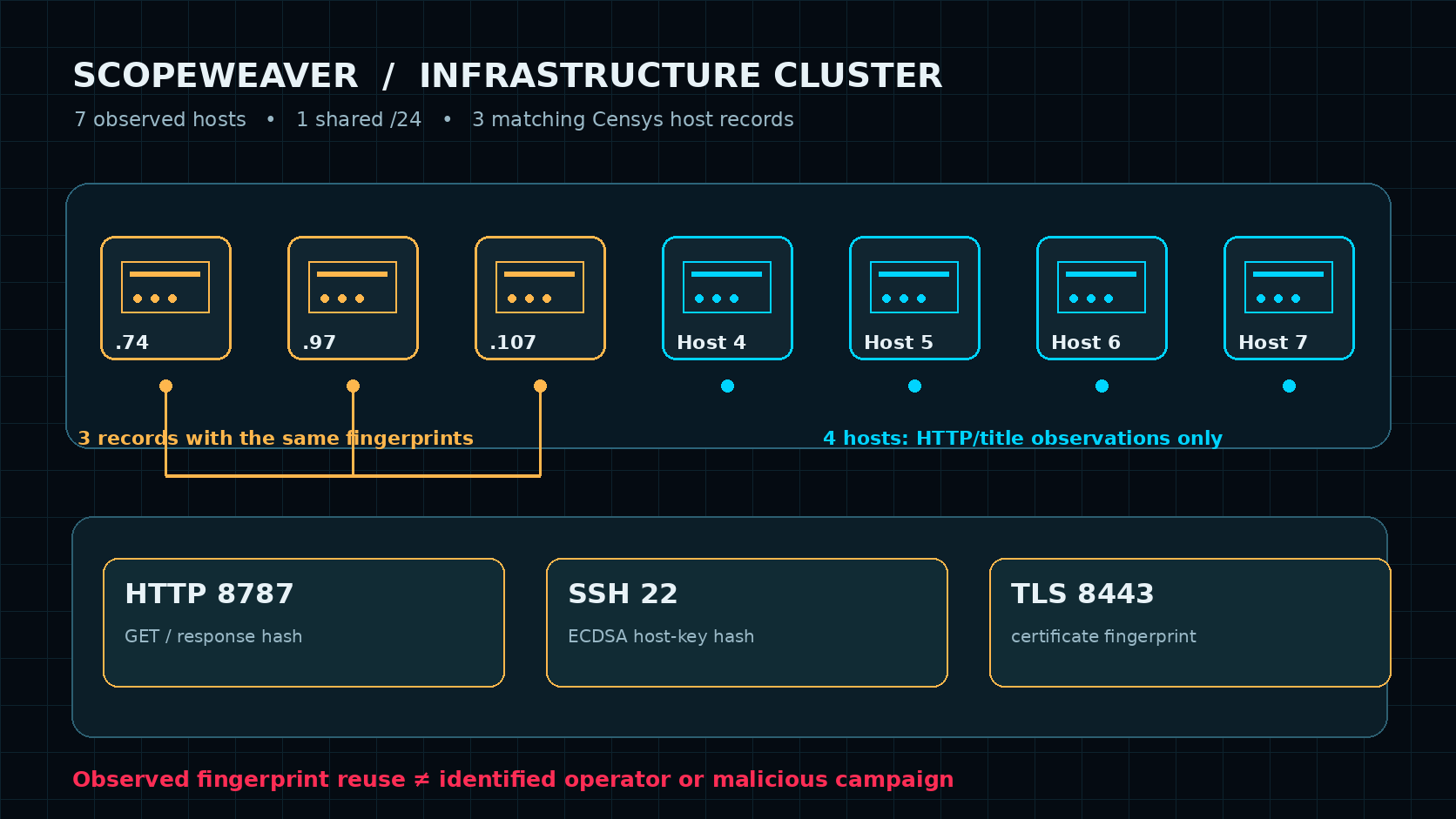
The collection notes also record three Censys host responses for 92.255.57[.]74, 92.255.57[.]97, and 92.255.57[.]107. The remaining four lookups returned HTTP 429 rate limits. For these three records, the notes show the same SHA-256 fingerprints:
| Observation | Port / context | SHA-256 recorded in the collection notes |
|---|---|---|
| HTTP response | 8787, GET /, HTTP 200 |
0251e2c850b8df3a14bbba8838a8429feb0656794fb550814dffefa1921efb27 |
| ECDSA SSH host public key | 22/tcp |
eb0a515c3996de45e9a116e1ed0ee3709e30646735bd43cf990180bd8332c266 |
| TLS server certificate | 8443/tcp |
608a25f7403425993d61e4433196b71b46dd85b711d7125ee45ab837ee52d25e |
The HTTP match applies to GET /, not to every path: the notes record a different hash for /login on one host. The TLS certificate was described as self-signed, with the subject and issuer sharing a common name that pointed to a fourth address within the same /24. Its not-before value was November 8, 2026, at 17:40:39 UTC; that is a certificate validity timestamp, not proof of when it first appeared online. These values should be checked against preserved Censys exports before making automated blocking decisions. Censys host API reference.
The combination is more informative than a shared page title, but it still has competing explanations. Identical SSH and TLS identities across multiple IPs are consistent with a cloned image in which keys were not regenerated, a shared service exposed through multiple addresses, or deliberate fleet deployment. BadByte documented reused keys in a different ARTEX distribution, illustrating why a repeated key should trigger a comparison, not an immediate actor attribution. BadByte's trojanized image was a separate supply-chain case; our ScopeWeaver sample has not been linked to that image or backdoor.
Here the evidence is firmer because it does not depend on transient scan results.
Censys published the following title-based ARTEX signature, requiring both a title that begins with the ARTEX brand and a reference to Next.js static assets:
(web.endpoints.http.html_title=~"^ARTEX[ :—]" and
 web.endpoints.http.body: "_next/static")
or
(host.services.endpoints.http.html_title=~"^ARTEX[ :—]" and
 host.services.endpoints.http.body: "_next/static")
In the ScopeWeaver v0.8.1 source, the application name is ScopeWeaver and the page metadata title is loaded through swt("interface.m2410"). Its Next.js root layout publishes that title to the HTML metadata. The supplied source-code comparison recorded six default ScopeWeaver titles, all beginning with ScopeWeaver, while the ARTEX Global configuration at a fixed revision defines five locale-specific titles, each beginning with ARTEX.
The conclusion is narrow but important: a title regex anchored to ARTEX cannot match a title anchored to ScopeWeaver, regardless of whether both pages contain _next/static. That establishes a signature coverage gap, not a complete Censys detection failure. Censys already supports ScopeWeaver as a separate threat label; RST Cloud and ScanMalware have also documented broader family-aware hunting approaches.
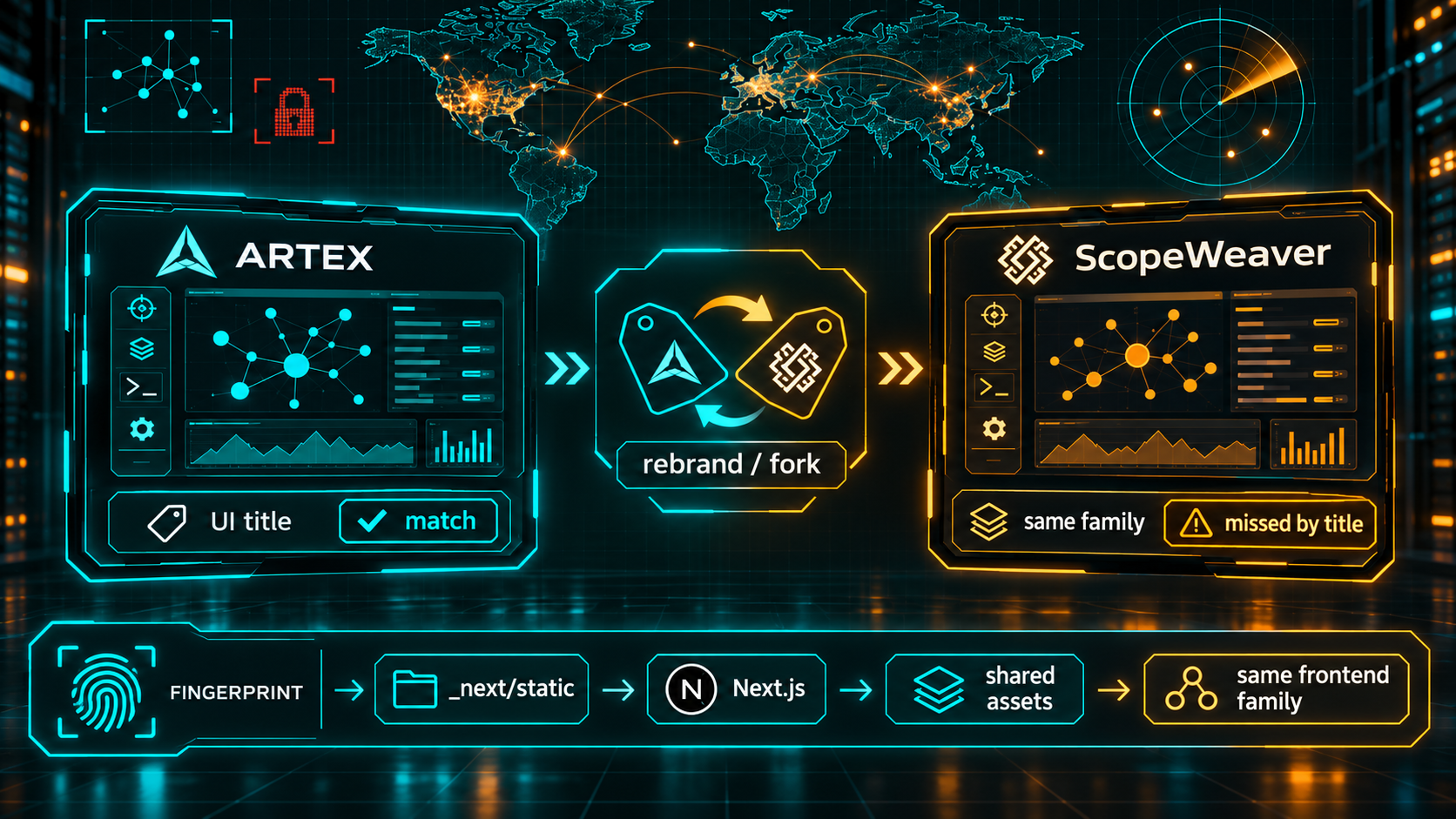
This distinction suggests a more durable strategy: use titles as convenient indicators, but corroborate them with multiple features that survive a rebrand—such as application-specific resources, build artifacts, structural HTML patterns, and independently distinctive service metadata. Generic Next.js assets alone are not enough: thousands of unrelated applications serve _next/static.
We also checked deployment sources at fixed Git revisions. The archived ARTEX Docker Compose configuration publishes 8787:8787, meaning the host port is exposed on all host interfaces by default unless a higher-level network policy intervenes. In contrast, ARTEX Global's Compose file defaults to ${ARTEX_BIND:-127.0.0.1}:8787:8787, making it loopback-only unless configured otherwise. Docker documents these publishing semantics.
The original build script also supports an ARTEX_BUILD_VERSION override and reusing an existing compiled frontend. Titles, version labels, exposed ports, and UI resources can therefore be inherited from a common package or provisioning choice. Correlations that depend on one shared deployment decision should not be counted as multiple independent proofs of a shared operator.
A separate security caveat is documented in the ScopeWeaver v0.8.1 release notes: defining an engagement's scope guides agent behavior and asset filtering but does not by itself technically restrict network access. Enforcing allowed destinations requires interception rules and external egress controls. This is a product-security observation, not evidence that the exposed consoles in our sample violated their configured scopes.
Two independent surveys show how much hosting topology can distort visibility.
| Published study | Population described | Why the count differs |
|---|---|---|
| Censys ARC, November 5 | 1,465 exposed ARTEX hosts in its snapshot | A title-and-body signature, provider coverage, scan timing |
| Check Point Research, November 5 | 2,557 historical/current systems; 1,608 live public systems in its study | Broader time scope and separate identification method |
The concentration is striking. Censys attributed 493 of its hosts to PEG Tech and 157 to Yancy, a combined 650 / 1,465 (44.4%). The two PEG Tech prefixes 38.11.173[.]0/24 and 38.11.221[.]0/24 each held 125 hosts. Check Point separately identified 125 addresses in each of these blocks with a sco-fix2 version label, plus five more in another range. The agreement across publications is strongest at the prefix-and-count level. It does not show that every address corresponded to a unique server or operator, nor does it establish that the label persisted across later scans.
The provided OffPerimeter notes include four subsequent public web captures of a Chinese-language ARTEX login page on port 8790 within those published prefixes. Those references are useful for historical comparison, but the article does not elevate them to a new actor cluster.
| Assessment | Confidence | Basis |
|---|---|---|
| ScopeWeaver is a rebranded ARTEX-lineage framework | High | Independent reporting and public source code |
| ARTEX-title-only signatures miss ScopeWeaver-default titles | High | Published Censys query versus source-defined titles |
| The supplied passive notes contain a seven-IP ScopeWeaver concentration | Medium / provisional | Public capture IDs and notes |
| Three of those IPs shared HTTP, SSH, and TLS fingerprints at the noted collection time | Medium / provisional | Censys hash values transcribed in notes; raw response exports not included |
| All seven hosts were coordinated by one operator | Unresolved | Multiple equally plausible infrastructure explanations |
| These hosts belong to a named threat actor or an active intrusion | Not established | No operator, victim, task, payload, or intrusion telemetry linking them |
The distinction is especially important because an offensive-security dashboard is dual-use software. A publicly reachable login page is a defensive exposure signal; it is not proof of compromise, hostile intent, or a successful attack. Likewise, same-key infrastructure can be caused by poor key hygiene rather than adversary coordination.
The most useful outcome is a repeatable method that defenders can apply to assets they own or are authorized to monitor:
For those building their own index, a practical data model keeps each observation separate: observed_at, ip, asn, port, http_path, title, http_body_sha256, ssh_hostkey_sha256, tls_cert_sha256, source, and collection_limitations. Never collapse those fields into a single binary “malicious host” label.
Our working hypothesis is that some installations in the seven-address cluster may have originated from the same provisioning process or shared backend. The observed reuse of SSH and TLS identities strengthens the case for a technical relationship among the three Censys records, but does not select one explanation. Shared provider templates, cloned virtual-machine images, copied service keys and coordinated deployments all remain plausible.
A malware sample would add analytical value only if supported by a defensible link: for example, a published sample containing a corroborated endpoint, infrastructure configuration, a validated session artifact, or an independent incident report connecting the sample to the same operator. No such linkage has been established for this cluster. We neither retrieved files from live third-party consoles nor analyzed a malware sample attributed to these hosts. Material described elsewhere in ARTEX reporting cannot automatically be attached to the ScopeWeaver addresses in this study.
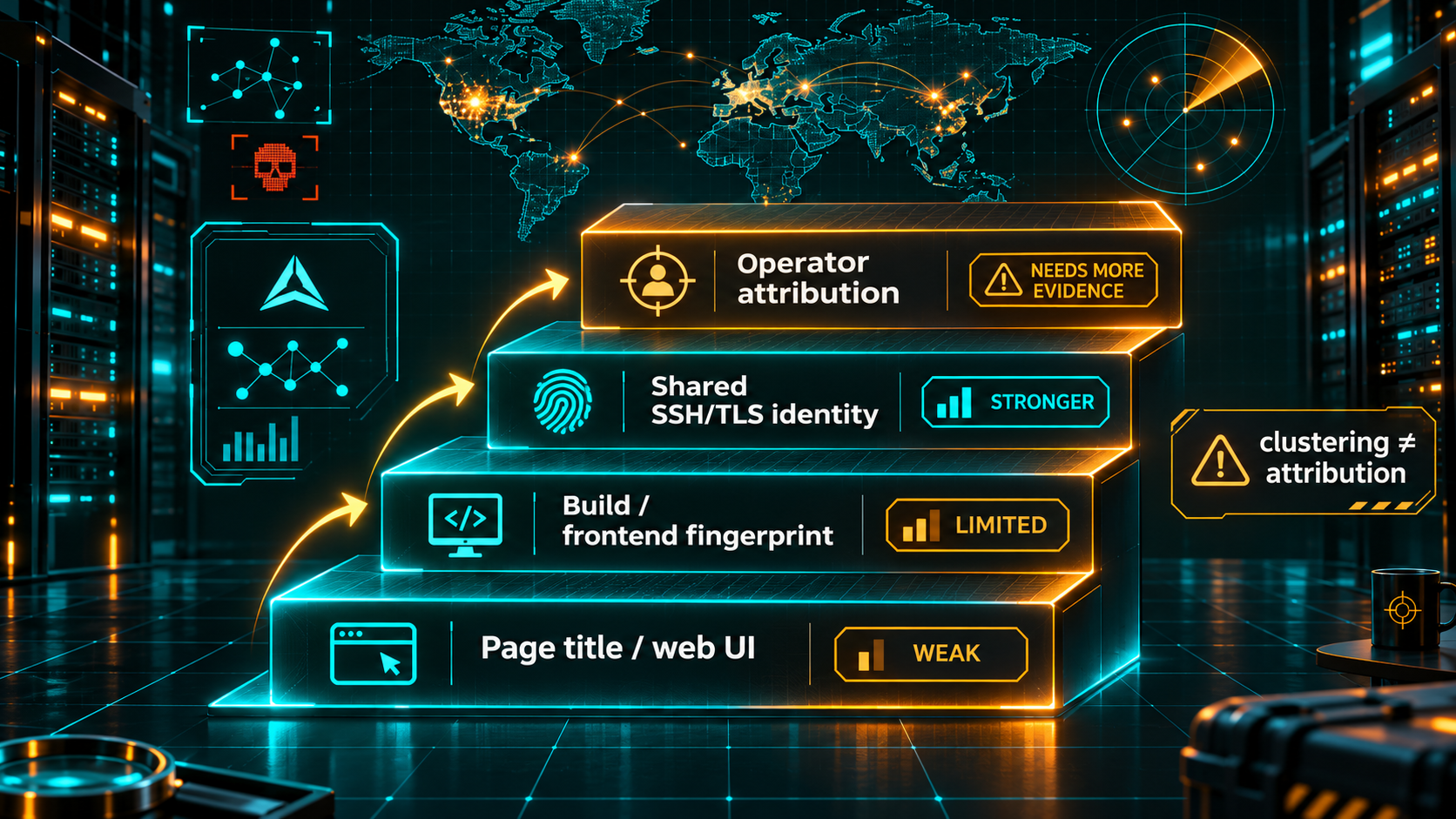
The easy conclusion would be that seven consoles in the same /24 form a threat-actor fleet. The evidence does not justify that. What it does justify is a more useful question: which signals are independent enough to distinguish a shared software package from a shared operator?
The ARTEX-to-ScopeWeaver rename offers a concrete answer about the first layer of detection. A title-anchored rule can become blind when the visible brand changes, even if the underlying software lineage persists. Service fingerprints help recover context, but duplicated keys and cloned deployments can mislead investigators in the opposite direction.
For threat intelligence, the objective is neither the largest list of addresses nor the most dramatic attribution. It is a finding that survives the next pivot—and a record of what remains unknown.
OffPerimeter
Climate is which agentic pentest console is loud this week. Posture is whether your hunting still keys off a page title that a rename can erase — while the software family stays in place.
 Research by OffPerimeter

After the rename, ScopeWeaver still leaves a trail — a /24 cluster, a missed host behind a shared cert, and a new domain that never showed up in the first title crawl.
A Telegram bot or Discord webhook in malware is not always the same job. Stealers drop files; designs like Telecord keep a live session. Webhook-only hunts miss that second pattern.

Fake AI-agent repos on GitHub hid the install step in the README. What the samples show about SmartLoader, StealC, and developer trust.
Explore your attack surface, credential exposure and threat intelligence with OffPerimeter.